


In part I of this series or articles I described line that proposes nature (genetic inheritance) as the fundamental determining factor for high-level sports development. Now it is the turn of the line that tries to explain exceptional performance mainly by the deliberate practice.
In 1993 Ericsson and colleagues published a lengthy article entitled: “The role of deliberate practice in acquisition of expert performance”. In this article the authors present a theoretical framework that attempts to explain that expert performance is the end result of prolonged individual efforts to improve performance.

To hold on to a position opposite to geneticists, Ericsson starts from Francis Galton’s tripartite definition of natural ability as the innate ability, zeal and power to do laborious work. 100 years earlier Galton stated that both heredity and learning are mixed when it comes to shaping not only our physical characteristics but also our psychological ones, they wanted to know which of the two elements explained a greater part of the variance in the human population in general. To do this, he used statistics and tools for measuring psychological characteristics.
If genetic factors determine performance, they could not be influenced by practice and training, and should remain relatively stable over time. Without neglecting that there are certain genetic conditions, such as height in some sports, muscle mass, oxidative capacity, etc. in others. The specific nature of the expert’s superior performance domain implies acquired knowledge and skills that are critically important to achieving that performance. The belief that the differences with the experts is due to genetic characteristics (talent) is so strong that their lack of explanation is seen as a minor problem and will be resolved in time. According to Galton’s axiom, improvements resulting from experience and practice appear for a limited time until a stable state of the maximum level of performance is reached. The factor that limits an increase in this level should necessarily be fixed and unchangeable due to environmental factors and it is here that the lack of empirical verification puts this theory in doubt.
Motivation and the conscious effort to improve are the fundamental conditions for acquiring new skills and perfecting them. When defining learning tasks it is necessary to take into account prior knowledge and above all to provide constant feedback on performance from the teacher / coach. Ericsson defines deliberate practice as that activity of practice for the student that can be carried out between sessions with the teacher. To ensure effective learning, explicit instructions about the best method should be provided and supervised by a teacher to individually diagnose errors and provide informative feedback. The instructor must organize the task in an optimal sequence and monitor progress and decide when to move on to a more complex task.
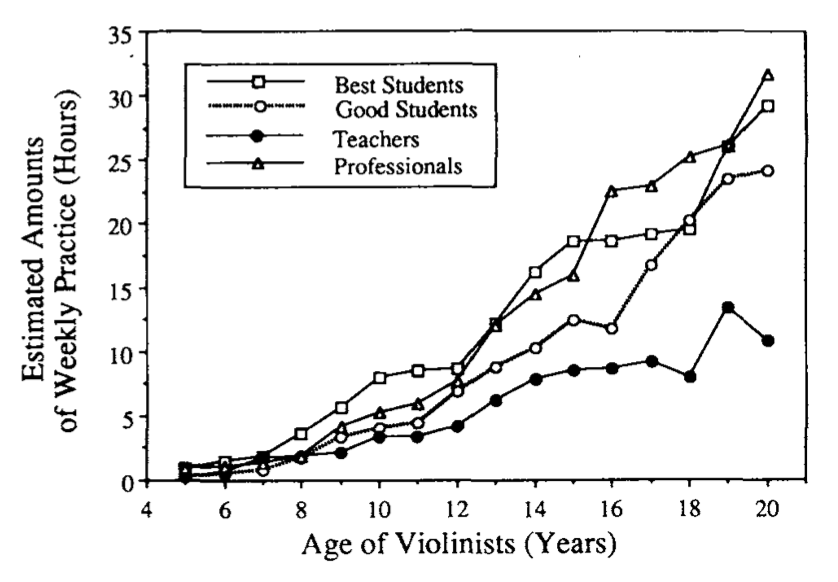
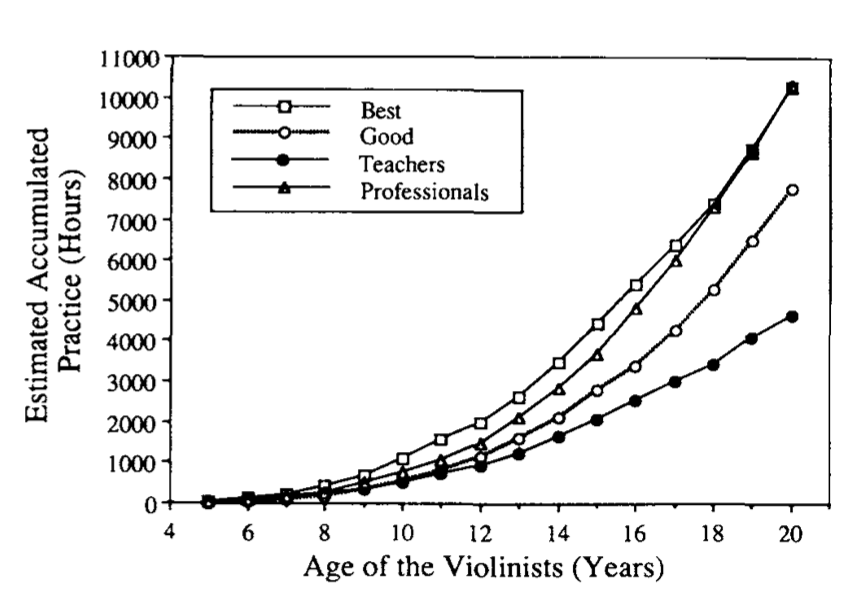
To check his theory, he studied violinists with different performances but their practice was with the characteristics described above. His findings led to what is now known as the 10,000 hour theory of practice. Senior violinists accumulated that many hours of deliberate practice throughout their careers, and as the rank of violinists decreased, so did the number of hours of practice. Through an extensive biographical interview, the weekly practice hours were estimated for each year since they began to play the instrument. To avoid influences that could confuse the data (especially working hours at the academy), the number of hours accumulated at the age of 18 was statistically analyzed. The best had accumulated 7410 hours of practice, while the average of the violinists considered good accumulated 5301 hours of practice. In their second study of the same article, they took it upon themselves to study young expert pianists with a group of amateur pianists.
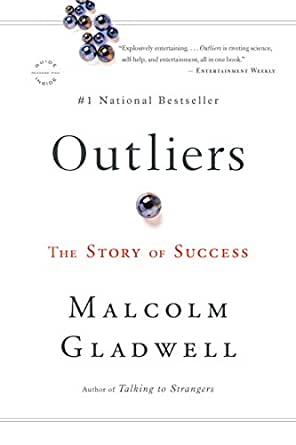
Several years after the article was published, the world best seller Outliers (2008) by Malcom Gladwell went on sale, who popularized the 10,000 hour rule to achieve excellence with an entire chapter dedicated to this “magic number”. The idea that excellence in performing a complex task requires a given minimum of practice, expressed as a threshold value, finds its way over and over again in master’s studies. From the popularity of the book some fundamentals taken from some study and with a complex reasoning analyzing The Beatles and Bill Gates, this number was becoming almost a general rule, without much foundation that sounds logical and obvious.
In a 2019 article, Ericsson himself refers to the book and clarifies that his research showed that a prolonged period of training and practice was required to achieve international-level performance, so there is no evidence in his studies of such a magic number. Moreover, in the article it mentions that there are individual differences in the characteristics that are correlated with the achieved performance that cannot be modified with practice, it also suggests that there could be hereditary factors that influence the ability to maintain attention and concentration to hook. in deliberate practice.

The sociologist Daniel Chambliss in 1989 published a very interesting work related to swimmers: “The mundanity of excellence”. For half a dozen years he studied swimmers of all levels, including Olympic swimmers, interviewing more than 120 swimmers and coaches. In his search for the definition of excellence, Chambliss distances himself from Ericsson’s idea: excellence is not the result of a quantitative difference, on the contrary, the quality of all aspects of the athlete is what makes the difference. By quantitative he means the amount of something, such as the number of hours, that is, doing more of the same, but a qualitative change involves modifying what is currently being done. These changes can be in technique, discipline or attitude that make a difference in the performance levels that are often not noticeable.
Focusing on explanation through practice detracts from heritage or talent. According to Chambliss, talent is the most generalized explanation to explain success, which lacks a solid argument. When athletes perform well in sports, they are said to have talent, but when they aren´t constant in their performance, they are said that they wasted talent. There are other factors that explain the success much more than the ¨talent¨ itself, it is very simple if you only see the champions of the Olympic games every four years on television, without taking into account all the work that is behind it. The human being wants to believe in talent.
For the author, excellence is achieved by carrying out actions, ordinary in themselves, carried out consistently and carefully, habitualized, compiled, added together over time. Excellence is ¨mundana¨.
In her book Grit (the power of passion and perseverance), psychologist Angela Duckworth, puts forward an interesting theory for achievement:
talent x effort = skill
skill x effort = achievements
Defining talent as the speed with which skills improve with effort, and achievements are what happens when those acquired skills are applied, Of course, also the opportunities that appear are very important even more than anything else in the world. individual plan, such as having an excellent coach or quality facilities.

In her research, the author studied applicants to enter the West Point Military Academy, where soldiers are constantly subjected to physical and mental tests to make them desist. In principle, those who exceeded the income were lucky and talented, but what mainly differentiated them was the combination of passion and perseverance, in other words what they had was what the author calls GRIT (English word equivalent to passion and perseverance to long-term goals). The four basic qualities of grit are: interest, practice, purpose, and hope.
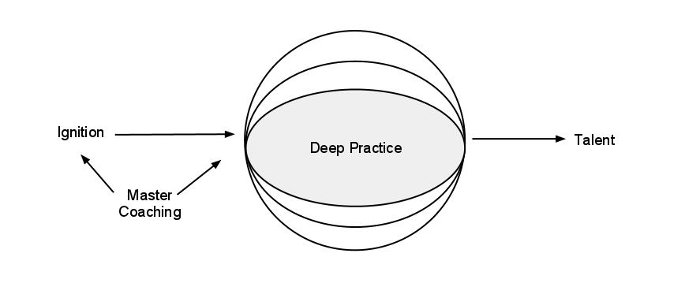
In his travels looking for the cradle of the great talents of sports and music, the writer Daniel Coyle identified three key elements that allow optimizing performance, they are:
Deep practice, related to Ericsson’s kind of deliberate practice,
Ignition (spark), we all need a little motivation to do any activity, but a high level of commitment is what differentiates successful athletes
Master coaching, those coaches who ignite passion, encourage deep practice and bring out the best in their athletes.
Presented the opposing positions between nature and nurture, and based on current knowledge, it is logical to assume that both aspects influence the development of the human being, one could say nature through nurture. It is not nature versus nurture, but the interaction of the two that drives development. This dichotomy should be abandoned since focusing exclusively on one option or the other overlooks the fact that successful performance is an immensely complex and dynamic process. All pieces of the puzzle must be present to build maximum performance.

References:
Chambliss, Daniel F. (1989). The mundanity of excellence: An ethnographic report on stratification and olympic swimmers. Sociological Theory 7 (1):70-86.
Coyle, Daniel (2009). The talent code : greatness isn’t born : it’s grown, here’s how. New York : Bantam Books
Duckworth, Angela (2016). Grit: The Power of Passion and Perseverance. New York, NY: Scribner, 2016
Ericsson, K. A., & Harwell, K. W. (2019). Deliberate Practice and Proposed Limits on the Effects of Practice on the Acquisition of Expert Performance: Why the Original Definition Matters and Recommendations for Future Research. Frontiers in psychology, 10, 2396. https://doi.org/10.3389/fpsyg.2019.02396
Ericsson, K. A., Krampe, R. T., & Tesch-Römer, C. (1993). The role of deliberate practice in the acquisition of expert performance. Psychological Review, 100(3), 363–406. https://doi.org/10.1037/0033-295X.100.3.363
Gladwell, Malcolm (2011). Outliers: The Story Of Success. New York : Back Bay Books, 2011. Print.
Leave a Reply