

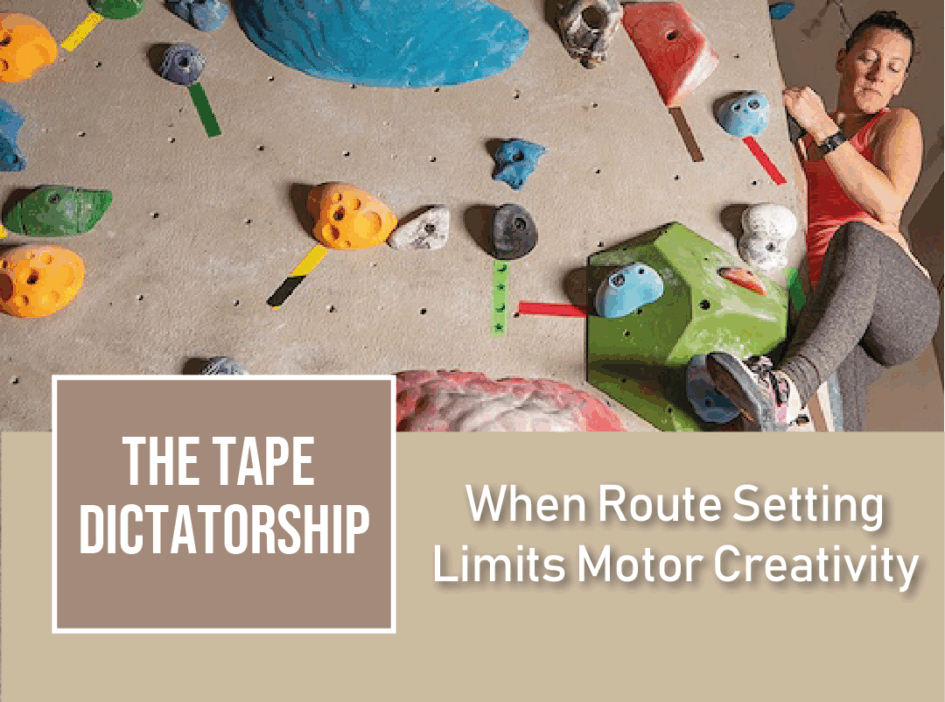
If you walk into a modern climbing gym today, the aesthetic experience is flawless. Immaculate walls, geometric volumes that look like contemporary sculptures, and holds neatly grouped by color tracing clean, distinct lines through the vertical chaos. We’ve come a long way from the dusty basements of the 90s, where thousands of pieces of tape marked overlapping routes in an indecipherable visual mess. Yet in this transition toward visual cleanliness and commercial appeal, we risk losing something fundamental. By sanitizing the environment, we’ve also sanitized cognition. We’ve gone from problem-solving to following instructions.
This phenomenon, which we could call The Tape Dictatorship (or the Color Dictatorship in its modern version), represents a silent crisis in motor learning within climbing. The premise of much commercial route setting today is absolute prescription: the route setter designs a specific sequence of movements (a closed choreography), and the climber’s success is measured by how accurately they reproduce that script. If you find an alternative solution, skip a hold, or use an intermediate foot that “wasn’t intended”, it’s often seen as cheating or “stealing” the boulder. But from the perspective of Ecological Dynamics and Complex Systems theory, breaking the beta is not a mistake; it’s the purest expression of motor intelligence.
To understand why this over-scripted model is problematic, we need to return to James Gibson’s concept of affordances, opportunities for action. On natural rock, the environment is neutral. The rock doesn’t care how you climb it; it simply offers countless micro-opportunities, a rough edge here, a tiny seam there, that the climber must perceive and select based on their own anthropometrics and abilities. Rock is an open problem. The modern commercial gym, by contrast, is increasingly a closed one.
When a route setter installs giant holds and blocks all other options with slippery volumes or boundary tape, they drastically reduce the landscape of affordances. Climbing is transformed from an activity of wayfinding into one of mere navigation. The difference is vast: navigating is following the blue line on your car GPS; wayfinding is interpreting the terrain with a map and a compass. By removing the uncertainty of what to do so that the climber only focuses on how to execute it, we atrophy reading ability and problem-solving capacity, kills that, ironically, are what differentiate an expert climber from a strong beginner.
This trend toward “author climbing”, where the setter imposes their morphology and style on the user, clashes directly with a key biological principle: degeneracy. In theoretical biology, degeneracy refers to the ability of structurally different elements to perform the same function or achieve the same outcome. It’s the basis of adaptability and robustness in living systems. A degenerate system is flexible; if one pathway fails, it finds another. Applied to climbing, a well-designed problem should allow multiple biomechanical solutions (multiple betas) to accommodate the enormous range of human variability. A climber who is 1.90 m tall and one who is 1.55 m should not be forced to move the same way.
Yet the Tape Dictatorship often punishes this variability. By enforcing mandatory moves—think of those coordination dynos with a single landing zone, or shoulder locks that require a minimum wingspan—the gym stops being a laboratory of motor exploration and becomes a morphological filter. The implicit message is: Move like me, or fall. Not only is this frustrating, it’s pedagogically poor. According to Nonlinear Pedagogy, learning occurs when the system self-organizes to find its own optimal solution within the constraints of the task. If the solution is imposed externally, we eliminate the search process—and with it, deep learning.
It’s striking to observe how this design methodology affects transfer to real rock. We’re seeing a generation of climbers who are incredibly strong and capable of performing complex coordination moves on plastic but who freeze on granite. Why? In the gym, they’ve learned to react to explicit stimuli (brightly colored holds that scream “grab here”), but they haven’t trained the perception of subtle cues or decision-making. They expect the rock to tell them what to do, but the rock is silent. They’ve been trained to solve crosswords where the letters are already filled in—and suddenly they’re facing a blank page.
If we analyze modern high-level competitions (IFSC), we see that setters intentionally create complex puzzles. Ironically, preparation for these puzzles in commercial gyms often relies on repeating closed patterns. The problem is that in a real competition (or at your limit project), when “Beta A” fails because you’re tired or nervous, you need to have Betas B, C, and D in your pocket. A climber raised under the Tape Dictatorship, who never had permission to explore alternative solutions, experiences cognitive panic when the main plan fails. They lack behavioral flexibility.
Of course, this isn’t about demonizing route setters, their work is monumental and essential to the industry. Standardization and “clean lines” help manage traffic in crowded gyms, make the sport more accessible to beginners (who get overwhelmed by too many options), and create an aesthetic that sells on Instagram. But we must be critical of the hidden cost of this model. By eliminating the “noise” and ambiguity of boulders, we also eliminate the rich information that feeds the nervous system.
One possible solution, or at least a necessary antidote, is the resurgence of spray walls or dense boards (walls full of holds with no apparent order). On these walls, the Tape Dictatorship disappears. The climber defines their own problems. The density of holds reintroduces the need to select: “I could use this foot… or that one… or the higher one.” Attention returns to the interaction between body and wall, not body and route setter.
Commercial gyms could also benefit from a paradigm shift in route design: moving from Prescriptive Setting to Landscape Setting. Instead of designing a step-by-step sequence, the setter could design “zones of difficulty” or movement landscapes that invite certain types of actions without forcing them. Allowing “bad feet,” intermediate steps, or holds that can be used in multiple ways enriches the environment. If a climber finds a creative way to bypass a hard move with a clever heel hook or extreme flexibility, that should be celebrated as a triumph of motor self-organization, not lamented as a design flaw.
Motor creativity doesn’t emerge in a vacuum; it emerges from interacting with constraints. But there is a fine line between a constraint that guides learning and one that strangles it. Tape, or a strict color code,when used dogmatically to forbid exploration (“that foot belongs to the pink route, don’t step on it”), acts as a cognitive straightjacket.
Ultimately, climbing is problem-solving. It’s a physical dialogue with uncertainty. If we eliminate uncertainty, we turn climbing into a kind of gymnastics: an execution of predetermined patterns judged by their fidelity to an ideal model. To recover the essence of motor learning, we need environments that allow error, variability, and surprise. We need to stop obsessing over whether we did “the correct beta” and start asking whether we found our solution.

Referencias
- Bernstein, N. A. (1967). The co-ordination and regulation of movements. Pergamon Press.
- Chow, J. Y., et al. (2016). *Nonlinear Pedagogy in Skill Acquisition: An Introduction.*Routledge.
- Edelman, G. M., & Gally, J. A. (2001). Degeneracy and complexity in biological systems. Proceedings of the National Academy of Sciences, 98(24), 13763-13768.
- Gibson, J. J. (1979). The Ecological Approach to Visual Perception. Houghton Mifflin.
- Seifert, L., et al. (2017). Role of route setting on climbing fluidity and exploration. Human Movement Science.
- Woods, C. T., et al. (2020). Wayfinding: How ecological perspectives of navigating dynamic environments can enrich our understanding of the learner-environment relationship in sport. Sports Medicine – Open.
Leave a Reply