

Adolphe Quetelet was born in the Belgian city of Gant on February 22, 1796, the fifth child in a family of nine siblings. A very talented student, his mathematical abilities were evident from an early age, receiving prizes in algebra, geometry, grammar and drawing in secondary school at the Lyce’e de Gent.
Quetelet seemed to be obsessed with determining the laws that govern the regularity of social and biological events with the same precision with which astronomers could determine the laws of movement of the stars. He was the one who first enunciated that certainty by which biological and social normality is associated with the frequency of appearance of certain characteristics, at the same time that he identifies abnormality or pathological processes with deviations from that mean or statistical frequency (Caponi, 2013 ).

In this way, the figure of Homme Moyen (average man) was born, as a source of comparison between individuals to determine the physical and moral conditions within a certain society. Quetelet enunciated predictive laws of social behavior, taking into account the statistical regularities of a society, specifically in the annual indices that showed a certain regularity such as suicide, crime and illegitimacy. This is how he makes it clear in one of his books:
¨ We can enumerate in advance how many individuals will stain their hands with the blood of their fellow men, how many will be counterfeiters, how many poisoners, with as much precision as we can enumerate the number of births and deaths that will occur in a society. Society contains within it the germs of all the crimes that will be committed, as well as the conditions for their occurrence. It is she who prepares her crimes, and the culprit is nothing more than the instrument that executes them ¨(Quetelet, 1991).
That average man is the result of the articulation of a series of physical, moral and intellectual causes that remain constant at certain historical moments and in certain geographical places. Quetelet (1991) argues that “if the average man were perfectly determined and defined, we could consider him as the type (or model) of beauty, and on the contrary, everything that more than resembles his proportions or his way of being would move away from them.” , would constitute deformities or diseases”.
Among the parameters studied by Quetelet is the BMI (body mass index or Quetelet index) that relates weight to height. The formula is simple: weight in kilograms over the square of the height in meters. Paradoxically, when developing this index, Quetelet had no interest in obesity, but rather he wanted to determine the characteristics of the average man and thus obtain the norm. Currently, the acceptable range of variability or degree of dispersion would be between BMI>25 and BMI<18, with a mean of BMI=21. This index is currently used to determine if one is below normal weight and at the upper end to classify obesity at different levels. Always understanding that it is an index that only indicates the relationship between weight and height,
In climbing, an index of less than 18 for women and less than 19.5 in men is currently taken as a symptom of a possible pathology called RED-S (Relative Energy Deficiency in Sport) which is a pathology caused by an imbalance between the energy expenditure and caloric intake that occurs in elite athletes, especially in sports that play against gravity. Thus, the IFSC (International Federation of Sport Climbing) regularly performs this test, and when finding a value below it informs the athlete and the corresponding National Federation and assistance is provided to form a support group for the athlete that includes medical, psychological and nutritional.
Many years before Quetelet defined his middle man, the architect of Julius Caesar in Ancient Rome, and then of Emperor Augustus, Marcus Vitruvius Pollio (80 BC – 15 BC), wrote the first known work of architecture to date, a collection of 10 volumes called ¨de Architecture¨. The work deals with materials, decorative techniques, construction, types of buildings, hydraulics, colors, mechanics, etc. In its time it did not have a great impact, but with the printing of the volumes in 1486,his concepts of beauty and harmony were particularly followed by the great architects of the Renaissance.

Under the inspiration of this work, Leonardo in 1492 made one of his most famous drawings: the Vitruvian man. It represents the nude male figure in two superimposed positions of arms and legs inscribed in a circle and a square. This work is known as the canon of human proportions. Together with some annotations in the same drawing, Da Vinci tried to capture the perfect proportions of the human body, inspired by the studies that Marcos Vitruvius himself carried out 15 centuries before.
¨Vitruvius says in his work on Architecture that nature distributes the measurements of the human body: 4 fingers make 1 palm, and 4 palms make 1 foot, 6 palms make 1 forearm, 4 forearms make the height of a man. And 4 foreams make 1 step, and that 24 palms make a man; and these measurements are the ones he used in his buildings.¨ These are part of Leonardo’s annotations describing different proportions of the human body.
The square of the “Vitruvian man” is centered on the genitals, and the circle on the navel. The ratio between the side of the square and the radius of the circle is the golden ratio. For Vitruvius, the human body is divided into two halves by the sexual organs, while the navel determines the golden section.In the Middle Ages, the golden section was considered to be of divine origin: it was believed to embody the perfection of divine creation.

According to Leonardo, man was the model of the universe and the most important thing was to link what he discovered inside the human body with what he observed in nature.
All these proportions make it possible to determine the average climber and from there to obtain data that allow making decisions regarding the selection and detection of talents, in the event that we consider anthropometric traits within the criteria. There are numerous tests that allow athletes to be evaluated and measured. In the figure below are some of those tests. In particular, the Ape index is one of the relationships that is of most interest when evaluating the anthropometric profile of climbers (Watts et al., 2003, , Laffaye et al., 2014 and Ignjatovićet et als 2017), although studies on this parameter are contradictory in climbers. It consists of the relationship between the length of the arms and the height. In my opinion, for men having an index greater than 1.03 and for women greater than 1.01 is beneficial, since it implies greater reach in relation to the height. Always putting it in context, since the index by itself does not tell us anything; Alex Megos has 1.00.

But this text does not come to give us information about what is the ideal anthropometric profile of climbers; there is a lot of published literature on this, but rather on the use of the mean and standard parameters for training. To calm anxiety, in a study by Michailov et als (2009) on elite Boulder specialists, in women the height is (cm) 162.6 ± 11.6, the weight (kg) 54 ± 6.8, BMI 20.4 ± 1.1, %fat 16.6 ± 3.6, % muscle mass 41.6 ± 4.3 and for men the height is (cm) 174.6 ± 5.6, weight (kg) 67.3 ± 6, BMI 22 ± 1.4, % fat 5.8 ± 1.8, % muscle mass 47.4 ± 1.
Now suppose that the average height of the population is 1.67 m. and the unit of deviation is 10 cm, we will find that 1 out of 6.3 subjects will measure more than 1.77, 1 out of 44 subjects will measure more than 1.87 and the same in the inverse relationship. In a climbing / training class we are going to have a wide variety of students with different heights. Assuming that the normal APE index is around 1 (as Vitruvius suggested), there will be some that will have a range of 1.67 cm (the average) and others that will have it above or below it, hindering or favoring the resolution of the setted climbing problems. Therefore, for some it could be that the movement proposed by the teacher/coach can be carried out in a static and controlled manner and for others it should be dynamic, generating a completely different load in each of the climbers, both from a technical and physiological point of view. If we are faced with a session where the routes to be used for training have a specific technical content, the environment will undoubtedly have to be adapted to be able to comply with it. Generally, in climbing gyms that use a preset setting for their training sessions , it becomes very difficult to meet the technical objective.

In training theory, there are certain principles, which can be technically defined as heuristic laws or rules based on science, which, applied with common sense, guide us in how to achieve optimal adaptations in an athlete. Among them, and in my opinion, one of the most important is the principle of individuality, which dictates that sports training must be adjusted according to the characteristics and needs of each athlete.
In the case of collective training sessions, the individual prescription of the exercise is difficult. To do this, the trainer has to clearly explain what the activity consists of, and adjust the environment so that each of the students can meet the objective of the session. The trainer/professor must be able to have the power to modify the environment (the problems or routes) to adapt to the possibilities of each one of his students according to the objective of the class. It is important that everyone knows that they must train according to their abilities, without competing with anyone, and paying attention to the correct execution of the activity.
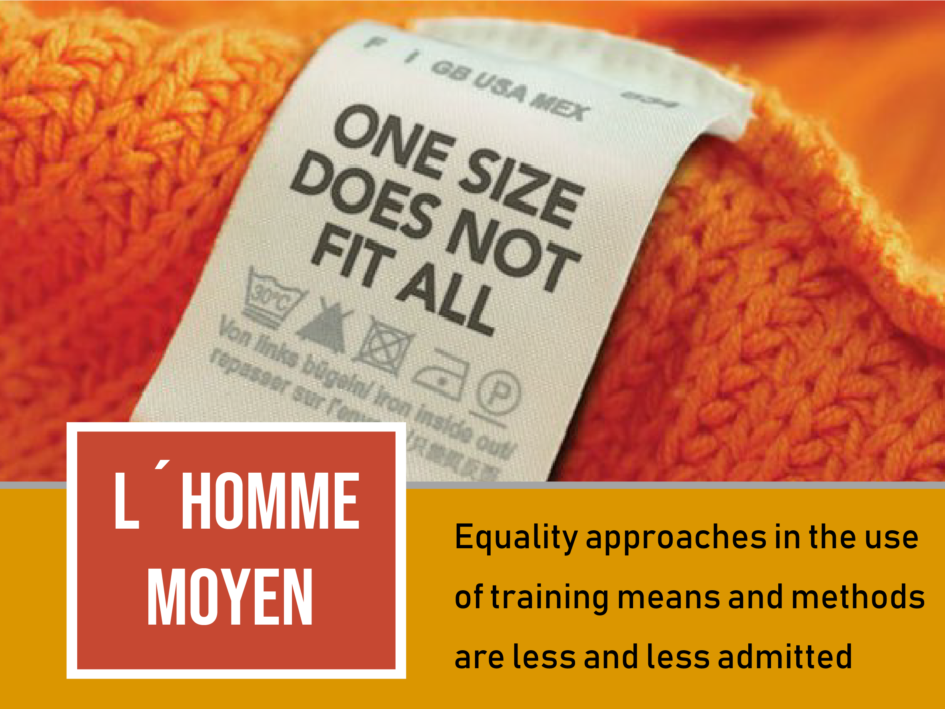
As the level of the students advances, the training becomes more individualized. In the classic book The General Theory of Sports Training, LP Matveev (2001) highlights: ¨ Equality approaches in the use of training means and methods , in the dosage of training loads and competitions… and the construction of the practice system are less and less admitted ¨.
Furthermore, the stimuli must be increasingly specific and individual, making group training practically impossible. According to Y. Verkhoshansky (2002), the increase in sports mastery (M) depends mainly on two factors: the increase in the athlete’s motor potential (P) and his ability to effectively take advantage of that training potential (H). As the mastery (M) that is represented on the x-axis increases, the athlete makes the most of his work capacity.

The basic constant of the training process is based on the increase in motor potential and the improvement by the athlete to make the most of it. The criterion to judge its effectiveness is measured through the degree of use of its motor potentialities, that is to say, that the stimulus corresponds to the current possibilities of the athlete.
The training stimulus, in this case the C curve, will grow exponentially as the training potential increases. The most common mistake made by athletes, and in our case by climbers, is to use inappropriate training stimuli (usually excessive) in relation to individual potential. This occurs mainly when trying to copy training from climbers with a different level and sports history, which implies a greater risk of injury or an incorrect adaptation of the organism that leads to a false peak of performance in relation to the optimal and individualized use of the load.
The same happens when we take the ¨homme moyen¨ when designing the movements of a class, for some it will be an optimal stimulus, for others not so much…

References
Caponi, S. (2013). Quetelet, el hombre medio y el saber médico. Hist. cienc. saude-Manguinhos 20 (3) Jul-Sep 2013
Ignjatović, M., Stanković, D., Pantelic, S.Puletić, M. (2017). The influence of certain anthropometric parameters on the results in lead climbing. Facta Universitatis, Series: Physical Education and Sport. 15. 321-328. 10.22190/FUPES1702321I.
Laffaye G, Collin JM, Levernier G, Padulo J. (2014). Upper-limb power test in rock-climbing. Int J Sports Med 2014: 35: 670–675.
Magiera, A. (2007). Biometric Model and Classification Functions in Sport Climbing.
Matveev, L. P. (2001). Teoría general del entrenamiento deportivo. Paidotribo.
Michailov, M.L., Mladenov, L., & Schöffl, V.R. (2009). Anthropometric and Strength Characteristics of World-Class Boulderers. Medicina Sportiva, 13, 231-238.
Quetelet, Adolphe. (1991) Sur l’homme et le développement de ses facultés. Paris: Fayard. 1.ed. 1835.
Verkhoshansky, Y. (2002) Teoria y metodología del entrenamiento deportivo. Paidotribo
Watts, P. B., Joubert, L. M., Lish, A. K., Mast, J. D., & Wilkins, B. (2003). Anthropometry of young competitive sport rock climbers. British journal of sports medicine, 37(5), 420–424. https://doi.org/10.1136/bjsm.37.5.420
Leave a Reply